
 DACH
DACH
 FR-BE
FR-BE
 US-CAN

- What are supplements for focus and concentration?
- How do focus and concentration supplements work?
- What does the research actually say?
- Which ingredients should you look for?
- Pharmaceutical stimulants vs natural supplements: what is the difference?
- Who typically uses focus supplements?
- How do you choose the best supplement for focus?
- Are focus supplements safe?
- Frequently asked questions
What Are Supplements for Focus and Concentration?
Supplements for focus and concentration are food supplement products formulated to support attention, mental clarity, and cognitive performance. They typically contain a combination of plant extracts, amino acids, vitamins, and minerals that target specific aspects of brain function.
These products sit within a broader category commonly referred to as nootropics. The term nootropic describes any substance that may support cognitive function without being a prescription medicine. The category spans everything from single-ingredient products such as caffeine tablets, through to comprehensive multi-ingredient stacks.
Supplements for focus and concentration are not the same as prescription stimulants. Prescription medications are controlled substances issued under clinical supervision for specific medical conditions. Supplements are food products, regulated differently, and are not intended to treat, cure, or manage any medical condition.

How Do Focus and Concentration Supplements Work?
Focus supplements work by influencing the brain systems that regulate alertness, attention, and mental energy primarily through neurotransmitter support, cerebral blood flow, and energy metabolism.
The brain's attention network is not a single system. It involves multiple interdependent pathways neurotransmitter production, energy metabolism, vascular supply, and stress regulation each of which can become a weak point when the brain is under sustained demand. This is a critical point when evaluating how supplements for focus and concentration actually work.
Caffeine, for example, blocks adenosine receptors. Adenosine is a compound that builds up in the brain throughout the day and creates the sensation of fatigue. By blocking its reception, caffeine promotes alertness and delays the onset of mental tiredness. Effective on its own but limited to that single mechanism.
L-theanine, an amino acid found in green tea, works through a completely different pathway. It promotes alpha brainwave activity the neural state associated with relaxed, attentive focus without causing sedation. Research suggests it works synergistically with caffeine, softening any jittery edge while preserving the alertness benefit. Together, they cover two separate systems. Separately, each addresses only one.
Ginkgo biloba targets a third pathway: cerebral blood flow. One of the most extensively studied botanical extracts in cognitive research, it is thought to support microcirculation in the brain, improving the delivery of oxygen and glucose to neural tissue. A standalone ginkgo supplement does not address alertness, neurotransmitter production, or energy metabolism.
B vitamins particularly B6, B9, and B12 play an essential role in neurotransmitter synthesis and energy metabolism in the nervous system. Low levels of these nutrients are associated with cognitive fatigue and reduced mental sharpness. B vitamins alone, however, do nothing for alertness or blood flow.
The pattern is consistent across every ingredient in this category: each compound addresses one part of the attention network, and none covers the full picture on its own. That is why the architecture of a formula matters as much as any single ingredient it contains. Supplements for focus and concentration that combine several complementary mechanisms give the brain more complete support than any single-ingredient product can.
What Does the Research Say About Focus Supplements?
The research base for supplements for focus and concentration is mixed but meaningful with certain ingredients carrying considerably stronger clinical evidence than others.
It is important to distinguish between ingredients with robust evidence and those with limited or preliminary support. The following represents the current evidence landscape for the most commonly used cognitive ingredients.
This Brainzyme review covers one user's experience with FOCUS ELITE™ after a year of daily use.Caffeine and L-Theanine
Caffeine and L-theanine have one of the strongest combined evidence bases in non-prescription cognitive support. Multiple peer-reviewed studies show the combination improves sustained attention, reaction time, and working memory compared to placebo. The European Food Safety Authority (EFSA) has approved health claims for caffeine relating to alertness and concentration.
Ginkgo Biloba
Ginkgo biloba has been the subject of over 400 clinical trials. Evidence supports its role in cognitive performance and attention, particularly in healthy adults. Results are modest and build over time rather than producing immediate effects. Cochrane reviews have noted consistent, if measured, evidence for attention and processing speed.
B Vitamins
B vitamins are well-established in terms of their role in brain function. B6, B12, and folate (B9) are essential for producing neurotransmitters including serotonin, dopamine, and norepinephrine. Population studies consistently link low B vitamin status with cognitive fatigue and reduced mental performance.
L-Tyrosine
L-tyrosine is an amino acid precursor to dopamine and norepinephrine. Studies suggest it may support working memory and cognitive flexibility under conditions of stress, sleep deprivation, or high cognitive demand. Effects are typically most noticeable when the brain is already under strain rather than under baseline conditions.
Panax Ginseng
Panax ginseng is a well-researched adaptogenic root used in traditional medicine for centuries and now backed by a growing body of clinical evidence. Studies suggest it may support mental energy, working memory, and cognitive performance during sustained mental effort, as well as helping regulate the stress response. It is included in the Brainzyme FOCUS ELITE formula.
Where evidence is limited or inconsistent, responsible supplement brands will not make exaggerated claims. Readers should be appropriately sceptical of any product that promises dramatic or rapid cognitive results beyond what the ingredient science supports.
Which Ingredients Should You Look For in the Best Focus Supplements?
The best supplements for focus and concentration contain a combination of evidence-backed ingredients at appropriate dosages, not a single high-dose compound, and not a long proprietary blend with undisclosed amounts.
This distinction matters. A caffeine tablet addresses alertness. A ginkgo biloba capsule supports blood flow. A B-complex helps with neurotransmitter production and energy metabolism. Each has genuine value, but each is also working in isolation covering one pathway while leaving the others unsupported.
When evaluating supplements for focus and concentration, look for the following core ingredients, and consider what each one and what it alone can and cannot do:
- Caffeine from Guarana and Matcha Promotes alertness by blocking adenosine receptors. Natural sources like guarana and matcha release caffeine more gradually than synthetic caffeine, supporting a steadier energy curve. On its own, it does not support neurotransmitter production, blood flow, or stress regulation.
- L-Theanine Supports relaxed alertness through alpha brainwave activity. Works best paired with caffeine in a 2:1 ratio; alone it lacks the alertness-driving effect caffeine provides.
- Ginkgo Biloba Supports cerebral blood flow and antioxidant activity. Builds over time rather than producing rapid results. Addresses a pathway that neither caffeine nor B vitamins touch.
- B Vitamins (B6, B9, B12) Essential for neurotransmitter synthesis and neural energy metabolism. Foundational nutrients that do not address alertness or blood flow directly.
- L-Tyrosine Precursor to dopamine and norepinephrine. Most useful under mental fatigue or stress. Adds a stress-resilience dimension that caffeine and ginkgo do not cover.
- Choline Supports acetylcholine production, the neurotransmitter most associated with memory and sustained attention. A pathway that no other ingredient on this list addresses directly.
- Zinc and Magnesium Trace minerals that underpin neurotransmitter regulation and nervous system function. Deficiency in either is associated with cognitive fatigue and poor attention.
- Panax Ginseng An adaptogenic root with a long evidence history in cognitive research. Supports mental energy and stress resilience, and may help sustain attention during prolonged cognitive demand. Present in the FOCUS ELITE formula.
Each ingredient on this list is doing something distinct. None of them duplicates the others. That is the case for a multi-ingredient formula: not because more ingredients is always better, but because the brain's attention system requires support across several pathways simultaneously. A well-constructed stack covers those pathways in combination. A single-ingredient product, by definition, cannot.
As with all formulas, ingredient transparency is the non-negotiable signal. If quantities are hidden behind a proprietary blend, there is no way to assess whether any ingredient is present at a dose that matches the research behind it.
| Ingredient | Primary Mechanism | Evidence Strength |
|---|---|---|
| Caffeine + L-Theanine (Guarana, Matcha) |
Adenosine blockade paired with alpha brainwave promotion Natural sources like guarana and matcha support a more gradual energy curve than isolated caffeine Strongest evidence |
Multiple peer-reviewed RCTs; EFSA health claim approved Best-supported non-prescription cognitive pairing available High |
| Ginkgo Biloba |
Supports cerebral blood flow and antioxidant activity Effects build gradually rather than producing immediate results Gradual onset |
400+ clinical trials; modest but consistent cognitive support Cochrane reviews confirm attention and processing speed benefits Moderate,High |
| B Vitamins (B6, B9, B12) |
Essential for neurotransmitter synthesis and neural energy Low levels linked to cognitive fatigue and reduced attention Foundational support |
Well-established population-level evidence across reviews Particularly relevant where dietary intake may be inadequate High |
| L-Tyrosine |
Dopamine and norepinephrine precursor Most effective under stress, fatigue, or high cognitive demand Stress-state benefits |
Strongest evidence for working memory under cognitive load Routine-state effects are more modest than stress-state effects Moderate |
| Panax Ginseng |
Adaptogenic support for mental energy and stress resilience May help sustain attention and cognitive output during prolonged mental effort Stress and energy support |
Growing body of clinical evidence across cognitive and stress outcomes Effects build with consistent use; included in FOCUS ELITE Moderate |
| Choline |
Precursor to acetylcholine, the neurotransmitter for memory and attention Supports the cholinergic pathway distinct from all other ingredients in this list Memory pathway |
Well-supported nutritional role in cognitive function Deficiency linked to memory difficulties and reduced mental stamina Moderate |
Caffeine + L-Theanine (Guarana, Matcha)
Mechanism
Adenosine blockade paired with alpha brainwave promotion
Natural sources like guarana and matcha support a more gradual energy curve
Strongest evidenceEvidence
Multiple peer-reviewed RCTs; EFSA health claim approved
Best-supported non-prescription cognitive pairing available
HighPanax Ginseng
Mechanism
Adaptogenic support for mental energy and stress resilience
May help sustain attention and cognitive output during prolonged mental effort
Stress and energy supportEvidence
Growing clinical evidence across cognitive and stress outcomes
Effects build with consistent use; included in FOCUS ELITE
ModerateGinkgo Biloba
Mechanism
Supports cerebral blood flow and antioxidant activity
Effects build gradually rather than producing immediate results
Gradual onsetEvidence
400+ clinical trials; modest but consistent support
Cochrane reviews confirm attention and processing speed benefits
Moderate,HighB Vitamins (B6, B9, B12)
Mechanism
Essential for neurotransmitter synthesis and neural energy
Low levels linked to cognitive fatigue and reduced attention
Foundational supportEvidence
Well-established population-level evidence across reviews
Particularly relevant where dietary intake may be inadequate
HighL-Tyrosine
Mechanism
Dopamine and norepinephrine precursor
Most effective under stress, fatigue, or high cognitive demand
Stress-state benefitsEvidence
Strongest evidence for working memory under cognitive load
Routine-state effects more modest than stress-state effects
ModerateCholine
Mechanism
Precursor to acetylcholine, the neurotransmitter for memory and attention
Supports the cholinergic pathway distinct from all other ingredients in this list
Memory pathwayEvidence
Well-supported nutritional role in cognitive function
Deficiency linked to memory difficulties and reduced mental stamina
ModeratePharmaceutical Stimulants vs Natural Focus Supplements: What Is the Difference?
Prescription stimulants and natural supplements for focus and concentration differ fundamentally in their mechanisms, legal status, risk profiles, and intended uses. They are not interchangeable.
Pharmaceutical stimulants such as methylphenidate and amphetamine-based medications are prescription-only medicines in the UK and most regulated markets. They are prescribed for diagnosed medical conditions such as ADHD or narcolepsy, under clinical supervision. They are not available over the counter, and obtaining them without a prescription is illegal.
Natural supplements for focus and concentration operate within an entirely different regulatory framework. They are food supplements, not medicines. They do not claim to treat or manage any condition, and they are available without a prescription.
The practical distinction matters enormously. Supplements for focus and concentration may support everyday cognitive performance, mental energy, and sustained attention in healthy adults. They are not, and should not be positioned as, alternatives to prescription treatment for diagnosed medical conditions.
If you have concerns about attention difficulties, mood, or cognitive function that affect your daily life, speak with your GP before pursuing any supplement-based approach.
| Factor | Pharmaceutical Stimulants | Natural Focus Supplements |
|---|---|---|
| Regulatory category |
Prescription-only medicines Regulated as medicines under MHRA in the UK; FDA in the US Controlled substances |
Food supplements Regulated under food supplement legislation; not classified as medicines Over the counter |
| Availability |
Prescription required from a licensed clinician Obtaining without a prescription is illegal in the UK and most regulated markets Prescription only |
Available without a prescription from retailers and online No clinical evaluation required to purchase No prescription needed |
| Mechanism |
Direct and potent action on dopamine and norepinephrine pathways Amphetamines and methylphenidate produce rapid, strong neurochemical effects High-intensity stimulation |
Multi-pathway support through complementary ingredients Works across alertness, blood flow, neurotransmitter production, and energy metabolism Broader, gentler support |
| Intended use |
Treatment of diagnosed medical conditions Prescribed specifically for ADHD, narcolepsy, or other clinical indications Clinical use only |
Support for everyday cognitive performance in healthy adults Not intended to treat, manage, or replace clinical care for any condition General wellness use |
| Risk profile |
Higher risk of dependence, cardiovascular effects, and sleep disruption Side effects include appetite suppression, elevated heart rate, anxiety, and rebound symptoms Higher risk |
Generally low-risk for healthy adults at recommended doses Caffeine sensitivity and herb-drug interactions are the primary considerations Lower risk |
| Strength of effect |
Pronounced and rapid effects are strongly felt in most users Potency is the reason they require clinical oversight and controlled status High intensity |
Moderate and cumulative best results with consistent daily use Effects are real but more subtle; not a direct comparison to prescription potency Gradual and steady |
| Who they are for |
Individuals with a clinical diagnosis, under prescriber supervision Use outside a clinical context carries legal and health risks Diagnosed patients only |
Healthy adults seeking to support focus, energy, and mental clarity Not a substitute for prescription treatment or professional medical care Healthy adults |
Regulatory Category
Pharmaceutical Stimulants
Prescription-only medicines
Regulated as medicines under MHRA in the UK; FDA in the US
Controlled substancesNatural Focus Supplements
Food supplements
Regulated under food supplement legislation; not classified as medicines
Over the counterAvailability
Pharmaceutical Stimulants
Prescription required from a licensed clinician
Obtaining without a prescription is illegal in the UK and most regulated markets
Prescription onlyNatural Focus Supplements
Available without a prescription from retailers and online
No clinical evaluation required to purchase
No prescription neededMechanism
Pharmaceutical Stimulants
Direct, potent action on dopamine and norepinephrine pathways
Amphetamines and methylphenidate produce rapid, strong neurochemical effects
High-intensity stimulationNatural Focus Supplements
Multi-pathway support through complementary ingredients
Works across alertness, blood flow, neurotransmitter production, and energy metabolism
Broader, gentler supportIntended Use
Pharmaceutical Stimulants
Treatment of diagnosed medical conditions
Prescribed specifically for ADHD, narcolepsy, or other clinical indications
Clinical use onlyNatural Focus Supplements
Support for everyday cognitive performance in healthy adults
Not intended to treat, manage, or replace clinical care for any condition
General wellness useRisk Profile
Pharmaceutical Stimulants
Higher risk of dependence, cardiovascular effects, and sleep disruption
Side effects include appetite suppression, elevated heart rate, anxiety, and rebound symptoms
Higher riskNatural Focus Supplements
Generally low-risk for healthy adults at recommended doses
Caffeine sensitivity and herb-drug interactions are the primary considerations
Lower riskStrength of Effect
Pharmaceutical Stimulants
Pronounced and rapid effects are strongly felt in most users
Potency is the reason they require clinical oversight and controlled status
High intensityNatural Focus Supplements
Moderate and cumulative best results with consistent daily use
Effects are real but more subtle; not a direct comparison to prescription potency
Gradual and steadyWho They Are For
Pharmaceutical Stimulants
Individuals with a clinical diagnosis, under prescriber supervision
Use outside a clinical context carries legal and health risks
Diagnosed patients onlyNatural Focus Supplements
Healthy adults seeking to support focus, energy, and mental clarity
Not a substitute for prescription treatment or professional medical care
Healthy adultsWho Typically Uses Supplements for Focus and Concentration?
Supplements for focus and concentration are most commonly used by adults seeking to support mental clarity, sustained attention, and energy during cognitively demanding periods.
Common use cases include:
- Adults seeking a consistent daily cognitive support routine
- Students preparing for exams or revision-heavy periods
- Professionals managing high workloads, long meetings, or creative deadlines
- Individuals experiencing low-level brain fog or afternoon energy dips
- People looking to reduce reliance on excessive caffeine consumption
Supplements for focus and concentration are not just for high-performance contexts. Many people use them simply to reduce the mental friction of everyday tasks the kind of low-level cognitive load that makes it difficult to stay on task through a busy afternoon.
They are not appropriate replacements for adequate sleep, balanced nutrition, or medical care. Focus supplements work best as one element within a broader routine that already includes strong lifestyle foundations.
How to Choose the Best Supplement for Focus and Concentration
The best supplement for focus and concentration depends on your specific goals, sensitivity to stimulants, and the type of cognitive support you need.
Consider these four questions before choosing a product:
1. Do you want stimulant-based or stimulant-free support?
If you are caffeine-sensitive, work late, or already consume significant quantities of coffee, a stimulant-free formula may suit you better. Many quality products are formulated without caffeine or with very low amounts. Stimulant-free stacks often rely more heavily on adaptogens, B vitamins, amino acids, and botanical extracts.
2. Are ingredient amounts clearly disclosed?
Avoid proprietary blends that list ingredients but conceal individual doses. Transparency matters both for safety and for assessing whether ingredients are present at levels that match the research. A formula with ten ingredients at undisclosed amounts may contain most of them at meaningless doses.
3. Is the product manufactured to a recognised quality standard?
Look for GMP-certified manufacturing, third-party testing, or recognised certifications. In the UK, food supplements are regulated under the Food Supplements (England) Regulations 2003. Quality assurance in manufacturing affects both safety and the accuracy of label claims.
4. What specific cognitive outcome are you trying to support?
Some formulas are weighted towards sustained focus and energy. Others lean towards stress support and mood alongside attention. Matching the formula to your primary goal will give better results than choosing the most popular option. Our guide to understanding focus supplement ingredients covers how to read product labels in detail.
Are Supplements for Focus and Concentration Safe?
Most supplements for focus and concentration are safe for healthy adults when taken as directed, particularly those containing well-researched, food-derived ingredients. Safety depends on ingredient selection, quality standards, and individual health status.
The following considerations apply:
- Caffeine sensitivity varies considerably between individuals. Those sensitive to stimulants should start with lower-caffeine formulas or opt for stimulant-free products.
- Medication interactions possible with some herbal ingredients. Ginkgo biloba, for example, may interact with blood-thinning medications. Always check with a healthcare professional if you take prescribed medication.
- Pregnancy and breastfeeding most focus supplements are not recommended during pregnancy or breastfeeding unless specifically cleared by a clinician.
- Underlying health conditions individuals with cardiovascular conditions, anxiety disorders, or other diagnosed conditions should consult a GP before starting any new supplement.
- Young people supplements for focus and concentration are generally formulated for adults. They are not appropriate for children without specific professional guidance.
Long-term use of well-formulated, ingredient-transparent supplements at appropriate doses is generally considered low-risk for healthy adults. Starting at a lower dose to assess individual tolerance is always sensible.
Each ingredient in a well-constructed formula targets a different pathway: blood flow, neurotransmitter production, alertness, or stress resilience. No single compound covers all of them, which is why a multi-ingredient formula tends to work better than any one ingredient alone. The more of the brain's attention network you can support at once, the more noticeable the effect.
Why Brainzyme FOCUS Is a Different Kind of Focus Supplement
Brainzyme® FOCUS™ stands out because people can actually feel it working. Many supplements claim to improve focus but deliver little noticeable effect, usually because they rely on a single ingredient or ineffective dosing.
Focus isn’t controlled by one system. It depends on alertness, neurotransmitters, blood flow, stress response, and energy metabolism working together. If a supplement only targets one of these, the overall impact is limited.
Brainzyme® FOCUS™ is built to address this properly. Each formula combines ingredients that act on multiple pathways at once—caffeine and L-theanine for alertness, B vitamins for energy and neurotransmitter support, amino acids for dopamine and norepinephrine production, and botanicals for blood flow. The result is a more consistent and noticeable effect.
Trying to replicate this with separate supplements is difficult. Getting the right compounds, doses, and ratios takes time and precision, and most people get it wrong. A single formula removes that guesswork.
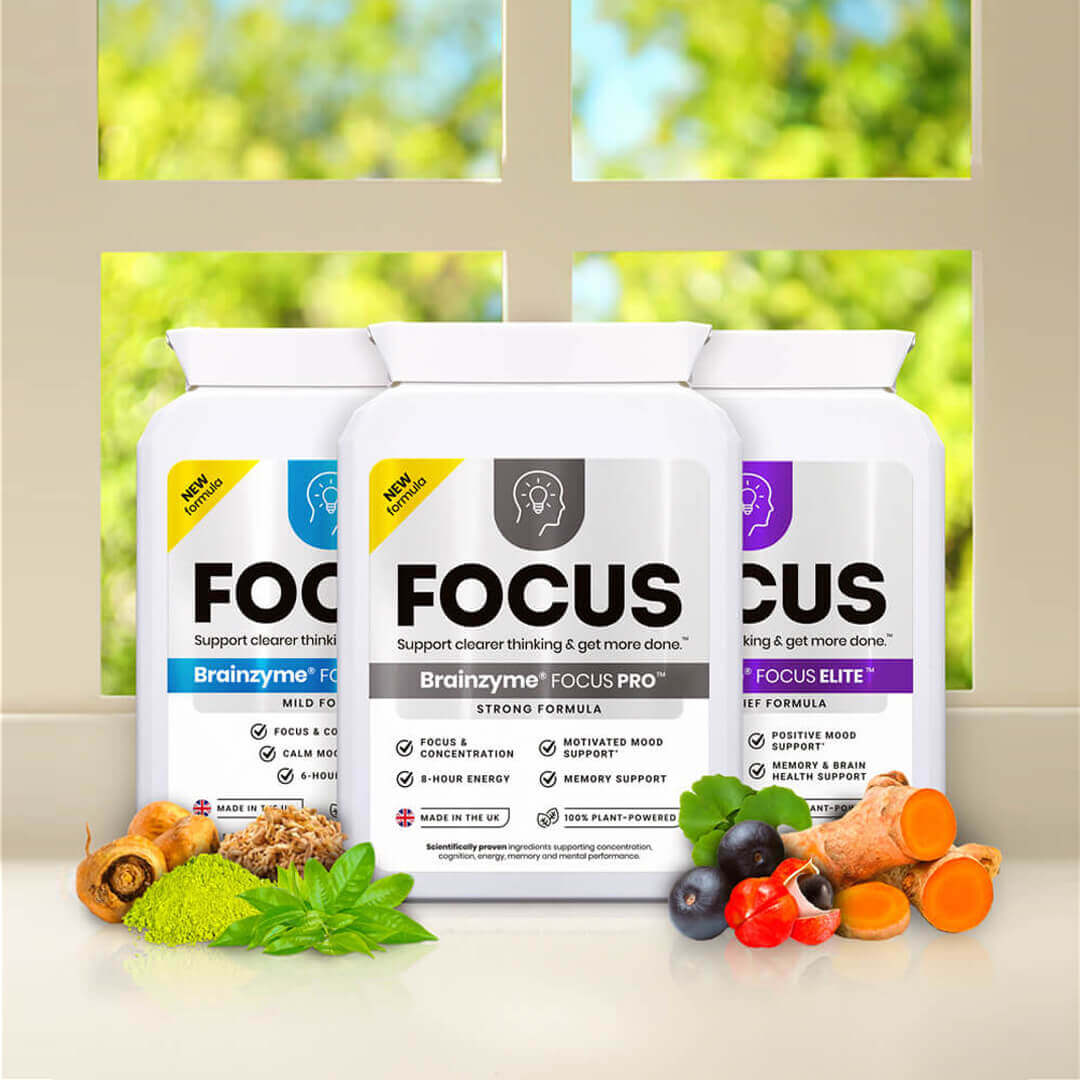
Three formulas are available, each built around a different cognitive needs:
Brainzyme® FOCUS PRO™ is the best-selling formula, built around strong, sustained focus and mental energy with motivated mood and memory support. It includes ingredients that support dopamine pathways, relevant for drive and staying on task.
Brainzyme® FOCUS ELITE™ provides stress-free focus and mental energy with positive mood and memory support. It includes ingredients that support GABA activity, and contains a gut-friendly probiotic that supports brain health through the gut-brain axis.
Brainzyme® FOCUS ORIGINAL™ is a mild formula with a steady focus profile and mental energy support, suited to those who want consistent support without higher-stimulation effects — and the only Brainzyme® FOCUS™ formula suitable for children aged 10 to 15.
- Focus supplements work through neurotransmitter support, cerebral blood flow, and energy metabolism
- Caffeine, L-theanine, ginkgo biloba, and B vitamins carry the strongest research backing
- Formula quality and ingredient dosing matter significantly transparency is a key signal
- Natural focus supplements are available over the counter; prescription stimulants require a prescriber
- Individual response varies supplements work best alongside good sleep, nutrition, and exercise
- Food supplements are not medicines and are not intended to replace professional medical advice
Frequently Asked Questions
Do focus supplements work?
Yes, focus supplements work, though the degree depends on which ingredients are present and at what doses. Compounds such as caffeine, L-theanine, ginkgo biloba, and B vitamins have meaningful peer-reviewed evidence for supporting attention, mental energy, and cognitive performance. Single-ingredient products tend to offer narrow benefits. Multi-ingredient formulas that combine complementary mechanisms show broader and more consistent effects. Results are strongest with consistent daily use rather than occasional dosing.
What is the best supplement for focus and concentration?
The best supplement for focus and concentration is a multi-ingredient formula that combines caffeine with L-theanine for alertness, ginkgo biloba for cerebral blood flow, B vitamins for neurotransmitter production, and L-tyrosine for stress resilience. No single ingredient covers all of these pathways simultaneously. A formula with fully disclosed ingredient quantities gives you the clearest way to assess whether each compound is present at a dose that matches the research behind it.
What supplements help with energy and focus?
The supplements most consistently linked to both energy and focus are natural caffeine sources such as guarana and matcha, B vitamins (particularly B6, B9, and B12), L-tyrosine, and magnesium. Caffeine reduces perceived fatigue and sharpens alertness. B vitamins support the energy metabolism pathways in the nervous system. L-tyrosine helps sustain cognitive output under mental demand. Combining these in one formula covers more of the energy-focus relationship than taking any single ingredient alone.
What is the best supplement for memory and focus?
The best supplements for memory and focus include choline, ginkgo biloba, B vitamins, and L-theanine.
Choline is a precursor to acetylcholine, the neurotransmitter most directly tied to memory formation and sustained attention. Ginkgo biloba supports the cerebral blood flow that recall depends on. B vitamins underpin the neurotransmitter synthesis involved in both memory and focus.
All three Brainzyme® FOCUS™ formulas contain choline, a full B vitamin complex, and L-theanine. Ginkgo biloba is included in FOCUS PRO™ and FOCUS ELITE™, making either a strong option if memory support is a priority alongside focus. Look for a formula that includes all of these at meaningful doses rather than token amounts.
What is a natural supplement for focus?
Natural focus supplements are those derived from plant, mineral, and nutritional sources rather than synthetic stimulants. The most researched options are matcha and guarana for natural caffeine, L-theanine from green tea, ginkgo biloba extract, choline, L-tyrosine, and B vitamins. These are food supplement ingredients, not medicines, and are available without a prescription. Combining several in one formula produces more consistent results than taking any one of them in isolation.
Are focus supplements safe?
Focus supplements are safe for most healthy adults when taken as directed and within recommended dosages. Brainzyme® FOCUS™ supplements contain only plant-powered ingredients, vitamins, and minerals that are classified as 'food' under UK Department of Health regulations and recognised as Generally Recognised As Safe (GRAS) by the US FDA.
How do I improve focus and concentration with supplements?
To improve focus and concentration with supplements, choose a multi-ingredient formula that covers more than one cognitive pathway. Look for caffeine paired with L-theanine for alertness, ginkgo biloba for blood flow support, and B vitamins for sustained energy metabolism. Take it consistently at the same time each day. Fast-acting ingredients like caffeine work within 30 to 60 minutes. Nutritional ingredients such as B vitamins and ginkgo build over two to three weeks of regular use.
Looking for a comprehensive focus supplement?
Try the Brainzyme® FOCUS™ Starter Bundle
The Starter Bundle includes all three Brainzyme® FOCUS™ formulas — ORIGINAL™, PRO™, and ELITE™ — each supporting a different focus priority. Try all three to find the one that works best for you.
Explore the Starter BundleReferences
- Giesbrecht T, et al. "The combination of L-theanine and caffeine improves cognitive performance and increases subjective alertness." Nutritional Neuroscience, 2010. Source
- European Food Safety Authority (EFSA). "Scientific Opinion on the substantiation of health claims related to caffeine." EFSA Journal, 2011. Source
- Birks J, Grimley Evans J. "Ginkgo biloba for cognitive impairment and dementia." Cochrane Database of Systematic Reviews, 2009. Source
- Kennedy DO. "B Vitamins and the Brain: Mechanisms, Dose and Efficacy, A Review." Nutrients, 2016. Source
- Neri DF, et al. "The effects of tyrosine on cognitive performance during extended wakefulness." Aviation, Space, and Environmental Medicine, 1995. Source
- Food Standards Agency. "Food Supplements (England) Regulations 2003." UK Government. Source
All references support claims made in this article. Brainzyme® FOCUS™ is a food supplement. This article is for informational purposes only and does not constitute medical advice.